


Mop Brushes

-

-
Sale

-

-
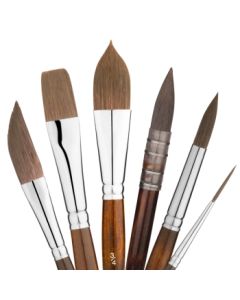 Art Essentials KAZAN Synthetic Squirrel Hair Brushfrom ₹425 to ₹3500
-

-
 Escoda Ultimo Tendo Synthetic Squirrel Hair Brushfrom ₹890 to ₹5410


Mop Brushes Built for Watercolour, Acrylic & Ink Work
A mop brush is the round, full-bellied watercolour brush with the largest paint-and-water reservoir in your kit — the one you reach for when you need to lay a wet sky in one stroke, soften a hard edge while it's still wet, drop a graded wash across half a sheet, or load the brush deep enough to paint for a minute without going back to the well. Art Lounge stocks the mop brushes Indian watercolourists actually use day-to-day — Winsor & Newton Cotman Synthetic Hair Brush (the entry-tier round mop in the Cotman line, ₹340 sale floor), Princeton Series 4750 Neptune Synthetic Squirrel Hair Brush (the mid-pro synthetic-squirrel mop, ₹425+), Escoda Ultimo Tendo Synthetic Squirrel Hair Brush — Series 1530 round mop / 1528 oval mop (Spanish hand-crafted Tendo synthetic-squirrel, ₹890+), Art Essentials KAZAN Synthetic Squirrel Hair Brush (Indian-priced synthetic squirrel, ₹425+), Princeton Series 3950 Velvetouch Luxury Synthetic Blend Brush (₹1,200), and Winsor & Newton Professional Water Colour Synthetic Sable Hair Brush (premium-pro synthetic sable, ₹815+). The range spans entry student through professional studio — every brush in the line is synthetic-fibre construction (no animal hair in any stocked SKU as of this page version), and is purpose-built for watercolour, gouache, ink, and fluid acrylic. Prices from ₹340 (Cotman synthetic, on sale) through ₹9,905 (Escoda Aquario Gold natural squirrel — currently OOS). (Also searched as watercolour mop brush, watercolor mop brush, mop brush for painting, mop brush for watercolor, artist mop brush, round mop brush, synthetic mop brush, squirrel mop brush, painting mop brush, mob brush, mope brush, mopbrush, brush mop — same product family, same range.) Free delivery across India.
Related categories on Art Lounge
- Watercolour Paint — Daniel Smith, W&N Professional & Cotman, Holbein, Mijello Mission Gold, Camel; tubes, pans, liquid & metallics
- Watercolour Sets — curated tube, half-pan, metallic and travel kits
- Watercolour Paper & Pads — Arches, Canson, Hahnemühle, Lana, Strathmore, Anupam, Scholar — the substrate your mop wash actually lives on
- Watercolour Palettes & Mixing Trays — Mijello airtight, Holbein folding aluminium, Art Tool Kit pocket — the mixing surface your mop loads from
- Round Brushes — pointed-round watercolour brushes for the detail work your mop can't do
- Wash Brushes — flat wide brushes for skies and gradient washes — the rectangular alternative to the round mop
- Synthetic Watercolour Brushes — the wider synthetic-hair watercolour brush range, by series
- Natural Hair Watercolour Brushes — Kolinsky sable, real squirrel, specialty natural hair
- Watercolour Brush Sets — round + flat brush bundles (mop brush sets currently sold as singles only — see set guidance below)
- Masking Fluid & Tape — preserve highlights before your mop wash hits
What a Mop Brush Actually Does (and What It Doesn't)
"Mop" in brush terminology refers to the shape — a round, full-bellied bundle of soft hair that swells outwards from the ferrule into a generous, dome-shaped body and then tapers to a softly-rounded point (or, on oval mops, a flat oval). It's not a hair-type description; both natural-hair and synthetic-hair brushes can be made in mop form. What the shape gives you is capacity — the largest paint and water reservoir of any watercolour brush format — and softness — a yielding, low-resistance touch that doesn't lift colour off paper if you go back over it while wet.
What a mop brush is for:
- Broad watercolour washes — covering a half-sheet of paper in a single loaded stroke, with no streaking or hard restart marks
- Skies, oceans, atmospheric backgrounds — the flat-wash and graded-wash technique base
- Wet-on-wet glazing — laying a glaze over a damp surface where capacity matters more than line precision
- Lifting colour — a clean damp mop will lift fresh wet paint off paper better than any other shape
- Soft-edge blending — feathering hard edges into soft transitions on watercolour, ink, fluid acrylic, or even soft pastel
- Loading large fluid quantities — for ink-and-wash, fluid acrylic, gouache thinned to a wash, watercolour with a granulating pigment
- Calligraphy and Eastern brushwork — single-loaded characters, monochromatic ink work where the brush's capacity sustains a long stroke
What a mop brush is not for:
- Detail and fine line work — a mop will never give you the snap, point, or precision of a kolinsky or synthetic-kolinsky pointed-round; use a round brush instead
- Heavy-body acrylic or oil paint — the soft hair has no spine for stiff paint; mops on heavy-body acrylic will flatten and splay; use acrylic brush sets with bristle or stiff synthetic for heavy-body
- Dry brushing or scumbling — the soft round bundle has no edge to drag dry across a textured surface; flat or filbert is the right shape
- Stippling and stencil dabbing — short-bristle stencil-mop brushes are a different format; see stencil brushes
If you searched for a household cleaning mop or a kitchen pocha: this is the artist's painting tool — a watercolour and acrylic brush — not the floor-cleaning mop. For household mops, try the home & kitchen section of a general-purpose retailer.
Mop Brush Range — Brand × Hair × Price
Mop brush pricing reflects three variables: hair construction (synthetic vs natural; entry-synthetic vs synthetic-squirrel-imitation vs synthetic-sable vs natural-squirrel-Kazan); maker's hand-finishing tradition (Spanish, Italian, Japanese, Korean, Indian, USA); and size — every brush in the range is sold across multiple sizes. Here's what each line actually is, what it costs, and where it fits:
| Brand & Series | Hair construction | Origin | Price range | Best for |
|---|---|---|---|---|
| Winsor & Newton Cotman Synthetic Hair Brush | Entry synthetic, white nylon-blend filament | UK | ₹340 – ₹4,365 (currently on sale) | First mop brush; students; daily-use entry pro; the "default" Indian art-school choice |
| Art Essentials KAZAN Synthetic Squirrel Hair Brush | Indian synthetic squirrel — soft, water-retentive synthetic taklon engineered to imitate Kazan natural squirrel | India | ₹425 – ₹3,500 | Indian-priced synthetic squirrel; great mid-tier for the price; substitutes for Camel mops at slightly higher quality |
| Princeton Series 4750 Neptune Synthetic Squirrel Hair Brush | Princeton's "Neptune" synthetic squirrel — long-lasting taklon with squirrel-like absorbency & release | USA | ₹425 – ₹4,700 (currently on sale) | Daily mid-pro studio mop; highly-regarded synthetic-squirrel mop in international watercolour communities |
| Winsor & Newton Professional Water Colour Synthetic Sable Hair Brush | Premium synthetic sable — stiffer than synthetic squirrel, snappier point, more spine | UK | ₹815 – ₹6,560 | Mop work that needs more snap (controlled edges, fluid acrylic on canvas, ink work) |
| Escoda Ultimo Tendo Synthetic Squirrel Hair Brush (Series 1530 round mop, 1528 oval mop) | Tendo fibre — Escoda's proprietary synthetic-squirrel imitation, considered the closest performing synthetic to real squirrel | Spain (handcrafted in Barcelona since 1933) | ₹890 – ₹5,410 | Pro studio + plein air; the synthetic-squirrel benchmark Indian watercolourists graduate to |
| Princeton Series 3950 Velvetouch Luxury Synthetic Blend Brush | Multi-fibre synthetic blend — combines several taklon weights for the best of soft + spine | USA | ₹1,200 (single size) | Multi-medium use — watercolour, fluid acrylic, ink — when you want one brush for several jobs |
| Princeton Series 4850 Aqua Elite Synthetic Kolinsky Sable Brush | Synthetic kolinsky sable — Princeton's flagship synthetic; sharp snap, very long point retention, high reservoir | USA | ₹325 – ₹3,520 (currently out of stock — restock priority) | When you need a kolinsky-sable feel without the price or animal-hair tradeoff; entry-floor of the page when in stock |
| Escoda Aquario Squirrel Hair Brush — Series 1130 | Real Kazan squirrel hair — natural fibre, the traditional benchmark for water capacity | Spain (handcrafted in Barcelona) | ₹3,835 – ₹8,285 (currently out of stock — restock priority) | Pro classical watercolour — the "real squirrel" benchmark for those who want natural-hair feel |
| Escoda Aquario Gold Squirrel Hair Brush | Premium real Kazan squirrel hair — Escoda's flagship natural squirrel mop | Spain (handcrafted in Barcelona) | ₹5,270 – ₹9,905 (currently out of stock — restock priority) | Top-of-line natural squirrel; pro studio, museum-grade pieces |
Prices shown are size-range price floors and ceilings; see each product page for exact size and per-size pricing. Verify live pricing on the listing.
Synthetic Squirrel — What It Actually Is
Most of the mops on this page are described as "synthetic squirrel" — and Indian customers reasonably ask: what does that mean? Is it real squirrel, fake squirrel, or just marketing? Here's the honest answer.
Real squirrel hair (specifically the Kazan-region squirrel from Russia) is the historical benchmark for watercolour mop brushes because it has three rare physical properties: extremely soft texture (almost no resistance against paper), unusually high water-holding capacity (long fibres with porous structure that traps water by capillary action), and a slow controlled release (the water leaves the brush gradually as you stroke, not all at once). For two centuries those three properties combined made real squirrel the only material that could lay a perfect graded wash.
Synthetic squirrel is the engineering attempt to replicate those three properties without using actual squirrels. The result is taklon (a polyester-based synthetic filament) that's been hollow-extruded, tapered, treated, and bundled to mimic squirrel's water behaviour. Different makers have different proprietary takes on the problem:
- Tendo (Escoda) — widely regarded as the closest synthetic to real squirrel feel; Escoda's Tendo Ultimo brushes are used by professional watercolourists who prefer the synthetic option.
- Neptune Synthetic Squirrel (Princeton) — Princeton's mid-pro range; durable, holds a point well, slightly snappier than Tendo; very popular in international urban-sketching communities.
- KAZAN Synthetic Squirrel (Art Essentials) — Indian-made, named for the Kazan squirrel benchmark it imitates; entry-mid-pro pricing for the synthetic-squirrel feel.
Synthetic squirrel costs less than real squirrel (often half or less), holds up longer to repeated washing without losing point, doesn't shed in storage, and has no animal-hair sourcing concerns. It does compromise slightly on the very softest feel and the absolute capacity ceiling — a real Kazan squirrel mop still holds marginally more water and feels marginally softer. For most painters, especially in India where natural-squirrel pricing is steep, synthetic squirrel is the sensible choice.
Mop Brush vs Wash, Hake & Oval Wash — Which Shape You Actually Need
"Mop" is one of several wash-capable shapes in the watercolour brush family. The shapes look similar at first glance but behave very differently in the hand — the wrong shape for the wrong stroke is the most common reason a new watercolourist's "wash" looks streaky or uneven. Here's the shape map:
| Shape | Head profile | What it's for | Where to find it |
|---|---|---|---|
| Round mop | Full-bellied round dome tapering to a soft point | Loaded broad washes, lifting, soft-edge blending, sky gradients, atmospheric work | This page (/mop-brushes) |
| Oval mop / oval wash | Flattened oval — wider than tall, soft hair | Side-loaded gradient washes; controlled-width skies; cleaner edges than round mops | /oval-wash-brushes (sibling shape category) |
| Wash brush (flat wash) | Flat rectangular bundle — straight chisel edge | Geometric flat washes; horizon lines; hard-edge wash blocks; covering large rectangular areas | /wash-brushes |
| Hake brush | Wide flat goat-hair bundle on a long bamboo handle (Japanese tradition) | Pre-wetting paper; very large fluid washes; pottery glazing; Japanese sumi-e and watercolour | Currently not stocked — see brand-redirects below |
| Round (pointed) | Slimmer round body with a true sharp point | Detail, line, controlled edge, character work — the opposite job to a mop | /round-brushes |
| Mottler | Wide flat or slightly arched bundle, deep belly | Very large flat washes (closer to a wash brush than a mop); decorative work; varnish application | /mottler-brushes (sibling shape) |
If you're laying a sky and you want soft, atmospheric edges with paint pooling and bleeding the way watercolour naturally wants to behave, you want a round mop. If you want hard-edge geometric washes with a defined edge, you want a flat wash brush. Hake brushes (Japanese flat goat-hair on bamboo) sit between the two — flat profile but very soft and absorbent — and serve a slightly different traditional role for pre-wetting paper and very large fluid washes.
How to Choose a Mop Brush — A Decision Path
Most painters do well with two mop sizes — one "big" (size 4–6 in international sizing, sometimes labelled differently across brands) and one "medium" (size 1–2). If you're just starting:
- Start with one size, mid-sized. A Cotman synthetic mop in a size 4 or Art Essentials KAZAN at a medium size, ₹425–₹700 range, will cover ~80% of what most watercolourists do.
- Add a second size only when you need it. If you find yourself painting half-sheets and the size 4 isn't holding enough water, add a larger Princeton Neptune or Escoda Ultimo Tendo. If you find you need more controlled mid-detail work, add a smaller round brush instead — not a smaller mop.
- Match the hair to the medium. For pure watercolour, synthetic squirrel (Tendo, Neptune, KAZAN) is the gold-standard balance. For ink-and-wash or fluid acrylic where you need a snappier point, synthetic sable (W&N Professional) is better. For very soft pure-wash work and the closest-to-real-squirrel feel, Escoda Ultimo Tendo is the benchmark.
- Don't pay for natural squirrel until you know you need it. Natural Kazan squirrel (Escoda Aquario, Aquario Gold) is genuinely better than synthetic squirrel — but the difference is only noticeable to experienced watercolourists, and the price premium is 3–5×. Most painters won't see ₹4,000–₹9,000 of value over the synthetic alternatives.
- Pair the mop with the right paper. A mop wash on cellulose paper (₹60–₹180/sheet) will buckle and cockle; on 100% cotton paper (Arches, Lanaquarelle, Saunders Waterford) the same wash will sit flat and dry cleanly. The mop is only as good as the paper underneath. See watercolour paper.
Mop Brushes for Acrylic, Ink & Gouache
Mop brushes are watercolour-first by design, but they work for several adjacent media — with caveats. Here's where they fit:
- Fluid (soft-body) acrylic on canvas or paper — yes, mop brushes work. Soft-body and fluid acrylics behave like thin watercolour and the mop's soft hair lays them down cleanly. Heavy-body acrylic — no, the soft mop has no spine for thick paint and will flatten. Use acrylic brush sets with bristle for heavy-body.
- Ink (sumi, India ink, fluid acrylic ink, calligraphy ink) — yes. Mops are excellent for ink; the high reservoir gives long single strokes and smooth gradients.
- Gouache (thinned to wash consistency) — yes. Same principle as watercolour, just slightly more pigment-dense. Mop brushes work cleanly with gouache.
- Watercolour pencil and water-soluble graphite (activating) — yes. A clean wet mop is the standard tool for activating watercolour pencil drawings and water-soluble graphite work.
- Oil paint thinned to "imprimatura" or transparent layers — yes for very dilute oil layers. Mops can be used for thinly-glazed oil work, especially on toned grounds. Clean with mineral spirits / odourless solvent immediately after use; oil residue degrades hair faster than water. For typical impasto or medium-body oil, use bristle or stiff synthetic.
- Pastel and dry media (blending) — yes, dry. A clean dry mop brush is a standard pastel-blending tool — it softens hard edges in soft pastel and chalk pastel without lifting pigment.
Mop Brush Sets — What's Available and What Isn't
Many Indian watercolourists ask for "mop brush sets" — a curated bundle of multiple sizes at a discount to buying singles. Honest answer:
As of this page version, Art Lounge stocks individual mop brushes only. Each of the nine product lines on this page is sold as a single piece, in one of several available sizes, at the per-size price. We do not currently offer a pre-bundled multi-size mop brush set SKU.
If you're building a starter mop kit on a budget, the practical approach is:
- Two-brush starter kit (under ₹1,000) — Cotman synthetic mop in two sizes (small + medium): roughly ₹340 + ₹600 = ₹940, full pro-grade range
- Three-brush practical kit (under ₹2,000) — KAZAN synthetic squirrel small + Cotman medium + Princeton Neptune large: roughly ₹425 + ₹600 + ₹950 = ₹1,975
- Four-brush studio kit (₹3,500–₹4,500) — Escoda Ultimo Tendo medium-small + Princeton Neptune medium + Cotman large + Escoda Ultimo Tendo extra-large; each picked for the role you'll use it most often in
(Custom-bundle pricing for studios and schools available on bulk order — contact Art Lounge for set quotes of 5+ pieces.)
Brands We Don't Stock — Substitutes from Our Range
Several mop brush brands and ranges are searched for by Indian customers but aren't currently in the Art Lounge range. Here's what we'd recommend instead from what's in stock:
- Camel Artist Mop Brush 73 Series (commonly searched as "camel mop brush", "camel artist mop brush") — direct substitute is Art Essentials KAZAN Synthetic Squirrel Hair Brush (₹425+), Indian-made synthetic squirrel at a similar mid-tier price point with stronger water-holding behaviour. Also try W&N Cotman Synthetic Hair Brush (₹340 sale floor) for the entry-tier Camel-equivalent role.
- Brustro Artists Natural Hair Mop Brush Set of 4 — direct substitute by-set is to build your own three- or four-piece kit from Art Essentials KAZAN + Princeton Neptune singles (see set-building guidance above). For natural-hair feel specifically, Escoda Aquario in a single size (when restocked) is the closer-to-Brustro natural option.
- Mont Marte Watercolour Mop Brush Artiste — squirrel-hair mid-tier; the closest in-stock substitute is Princeton Series 4750 Neptune Synthetic Squirrel Hair Brush (₹425+) for similar synthetic-squirrel performance, or Escoda Ultimo Tendo (₹890+) for a clear step-up in handle finish and Tendo fibre quality.
- Stationerie Petal / Calligraphy Rigger / Vegan Mop Set — Indian budget vegan synthetic; closest substitute is W&N Cotman (entry synthetic, vegan by construction) or Art Essentials KAZAN (Indian-made synthetic squirrel).
- Itsy Bitsy unbranded synthetic mop brushes (the ₹176–₹220 sized 14, 16, 150–165mm singles) — substitute is W&N Cotman (₹340 floor) or Art Essentials KAZAN (₹425) — better-finished hair, longer-lasting brushes.
- Hake brushes (any maker — Pebeo, generic Japanese hake, Mijello, Daler Rowney) — currently not stocked. Hake brushes are flat goat-hair brushes (different physical shape from a round mop), used for pre-wetting paper, very large fluid washes, and Japanese sumi-e. The closest functional substitute from our range is a flat wash brush or a very large Cotman / Escoda Ultimo Tendo round mop (size 14+) for the broad-wash role. We're working on adding a hake range — see procurement plans.
- Da Vinci Casaneo / Cosmotop Mix / Da Vinci squirrel mops — premium German pro mops not currently stocked; substitute is Escoda Ultimo Tendo (₹890+) for the synthetic option or Escoda Aquario / Aquario Gold (when restocked) for the natural-squirrel option.
- Rosemary & Co Pure Squirrel (UK indie favourite) — substitute is Escoda Aquario (when restocked) for natural-squirrel feel, or Escoda Ultimo Tendo for the synthetic alternative.
- Jackson's Pure Squirrel Mops Series 828 — same recommendation; substitute Escoda Aquario or Escoda Ultimo Tendo.
Mop Brush Care & Cleaning
Synthetic squirrel and synthetic sable mops last longer than natural hair if cleaned correctly. The two killers of watercolour mops are: (1) leaving paint to dry in the ferrule, which destroys the hair-bundle structure permanently, and (2) standing the brush bristle-down in a water jar, which splays the point.
- Rinse immediately after a session — clean water until the rinse runs clear at the ferrule, not just at the tip.
- For synthetic squirrel and synthetic sable — rinse with clean water only. No soap needed for routine watercolour. For deep clean every few months, a drop of mild brush-cleaning soap (or fragrance-free hand soap), gently lathered against the palm, then rinsed.
- Reshape the point — pull the wet brush gently between thumb and forefinger to restore the dome shape. Lay the brush flat to dry, or hang it bristle-down in a brush holder.
- Store flat or hung — never stored bristle-down standing in a jar. Even good brushes splay if stored that way for months.
- For acrylic users — clean within minutes of use. Acrylic dries fast and dried acrylic in a mop is unrecoverable; the brush is gone.
- For ink users — same principle. Most inks rinse with water; some shellac-based or pigmented inks need denatured alcohol. Test on a small section of the brush first.
Free delivery across India; price-match guarantee on listed brands; expert support on brush selection — write to hello@artlounge.in or browse the full brushes & painting tools catalogue for round, flat, filbert, fan, liner, mottler, angular and stencil shapes.



