


Art Essentials · 120 GSM Toned Paper
Start drawing on a mid-tone, not a blank page.
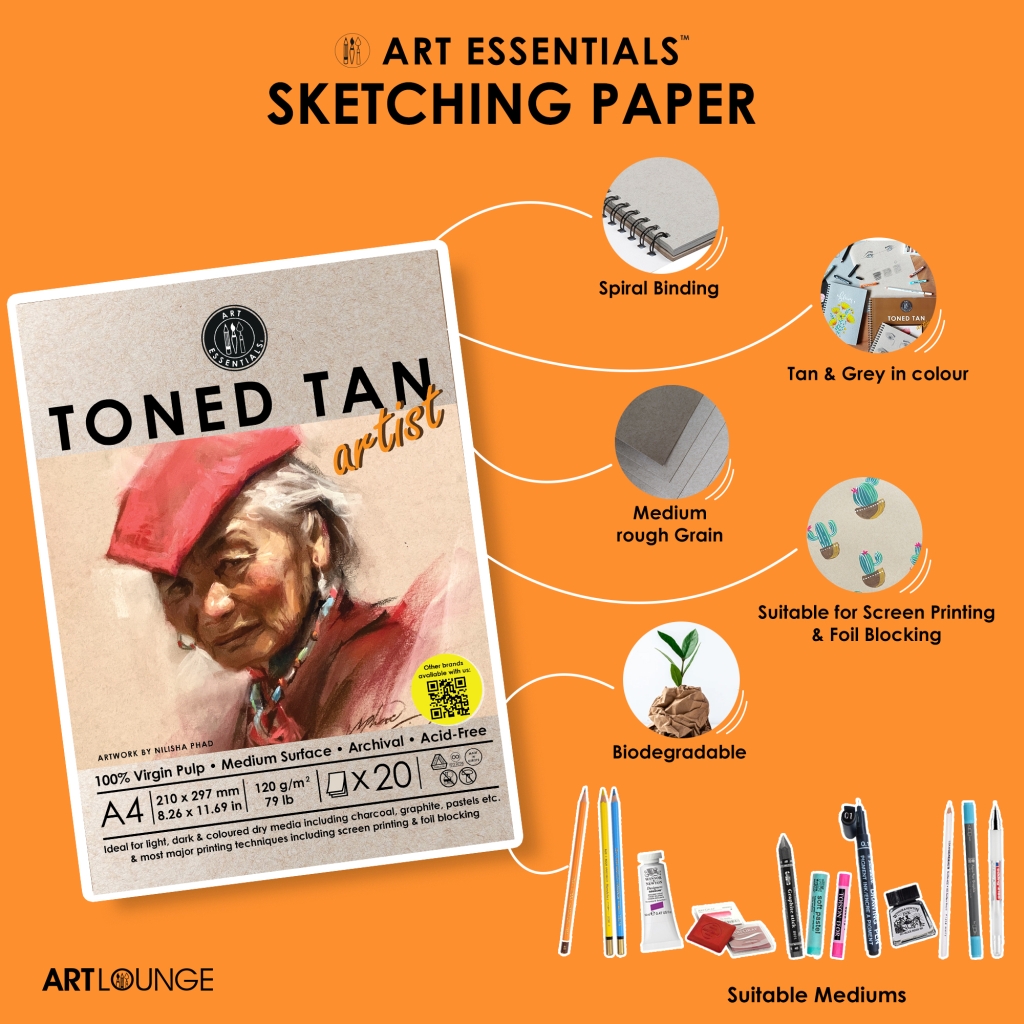
Tan and grey paper start you on a mid-tone instead of white. Dark shading sits into the surface, white pencil and gel pen show up clearly, and you skip the slow build-up of grey values that white paper forces on you.

Build your pack
Toned Sketching Paper
120 GSM · medium surface · acid-free · for all dry media
How you work on it
Three steps instead of a slow build-up
On white paper you build every value up from scratch. On toned paper the surface is already your mid-tone, so you only add the darks and the lights.
Pick your tone
Warm tan for portraits and colour work, cool grey for high-contrast and classical studies. The paper sets your mid-tone for you.
Add your shadows
Block in the dark areas with charcoal, graphite or coloured pencil — working down from a mid-tone, not up from white.
Add your highlights
Use white pencil, chalk or a gel pen for the lightest areas. Against a toned surface they read as bright highlights; on white paper they barely show.
Why artists use it
What a mid-toned surface gives you
Working on a mid-tone is a long-standing studio technique. Here is what it changes in practice.
White highlights show up
White pencil and gel pen read bright against the tone, so you can draw highlights directly. On white paper there is nothing for them to stand out against.
Less time spent shading
The mid-tone is already on the page, so you skip building up grey values from white and spend your time on the shadows and highlights instead.
Stronger contrast
Starting in the middle of the value scale, you only push slightly lighter and darker, which makes it easier to keep a full range of contrast in the finished drawing.
Works with every dry medium
Charcoal, graphite, chalk, conté, pastel, coloured pencil, pen and ink. The 120 GSM weight and medium tooth handle all of them.
The paper itself
What you're getting
- ✓120 GSM weightSubstantial enough to layer and blend without buckling.
- ✓Medium surface toothGrips charcoal and pastel, yet smooth enough to ink and detail.
- ✓Acid-free & archivalYour work stays true and won't yellow over the years.
- ✓Consistent, even toneEvery sheet is the same calibrated tan or grey — no patchiness.
- ✓100-sheet A3 or 200-sheet A4 polypackPlenty of paper to practise freely — both packs ₹499.
Tan or grey?
Which tone to start with
Many artists end up using both. Here is how to choose your first.
Toned Tan
Warm and earthy. Good for portraits and skin tones, makes coloured pencil look richer, and gives ink and comic work a warm base. The easier tone to start with.
Toned Grey
Cool and neutral. Best for high-contrast charcoal-and-white studies and classical value work, where you want a neutral tone that doesn't shift your colours.
“Drawing on a toned ground is the technique the Old Masters built portraits on — Michelangelo and Rubens reached for tinted paper so light and shadow could be added in both directions.”
A studio technique used for centuries
Questions, answered
Both packs are ₹499. A4 gives you 200 sheets (about ₹2.50 a sheet) and suits most sketching and studies. Choose A3 (100 larger sheets) when you want more room for full portraits or finished pieces.
Especially. Starting from a midtone makes value and contrast easier to read than a blank white sheet, so it's a genuinely helpful place to learn — not an advanced-only surface.
All dry media: charcoal, graphite, chalk, conté, pastel, coloured pencil, and pen/ink. Add white pencil, chalk or a white gel pen for highlights. It handles light ink washes, but it's built for dry media — not heavy watercolour or acrylic.
Any white — pencil, chalk, charcoal or gel pen — works. That's the whole point of a toned ground: you draw in two directions, adding darks and lights, instead of only shading down from white.
Both colours are in stock and ship within 24 hours from Art Lounge. If something isn't right, our standard easy-returns policy applies — checkout and delivery are handled securely on artlounge.in.
Try toned paper on your next drawing.
Choose tan or grey, add it to your cart, and start your next piece on a mid-tone instead of a blank white sheet.
Choose your paper →


